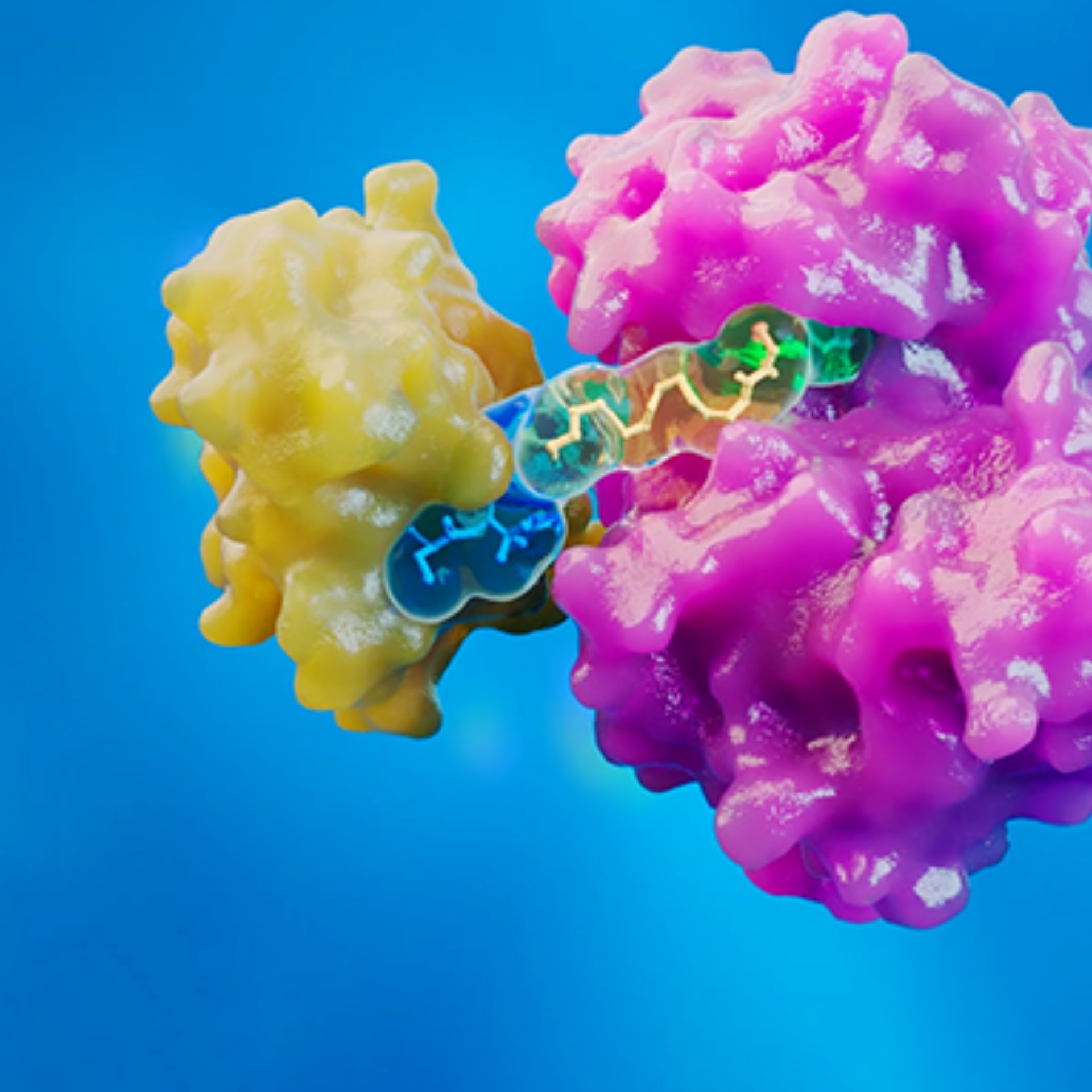
In May 2026, US regulators approved vepdegestrant, the first Proteolysis Targeting Chimera (PROTAC) therapy, marking a historic landmark for this drug class. PROTACs offer an exciting and highly promising alternative to traditional small-molecule inhibitors and biologics. Their unique design means they have the potential to treat diseases previously written off as "undruggable."
But, as is usually the case in drug development, nothing this promising comes easily. PROTACs present unique challenges that researchers must overcome early in the preclinical testing phase to reduce the risk of expensive delays or failures later in their journey.
One of the most significant challenges is that PROTACs don’t conform to the norms for absorption, distribution, metabolism, and excretion (ADME). And because they do not behave like conventional small molecules, they cannot always be evaluated in the same way. Conventional ADME workflows designed for small molecules can often yield misleading results when applied to PROTACs, requiring researchers to realign their models to avoid costly pitfalls. Explore five key ways PROTACs deviate from ADME norms, and how to account for them in preclinical testing strategies.
1. PROTACs Frequently Don’t Adhere to the Rule of 5
PROTACs typically have a molecular weight ranging from 800-1000 Daltons and contain many polar chemical bonds, which increase their topological polar surface area and hinder their ability to cross physiological barriers and cell membranes. These characteristics mean PROTACs regularly break Lipinski’s Rule of 5, which has been used to guide oral drug-likeness assessment.
PROTACs also exhibit high protein binding and poor permeability, demonstrate complex metabolic pathways, and often contain multiple chiral centers, all of which complicate their development.
To address these issues, developers can focus on optimizing the linker length of PROTACs, minimizing the polar surface area, and simplifying the ligand structure where possible. If PROTACs are to fulfill their potential, they will need to be suitable for oral administration, so the challenge is not simply to comply with the Rule of 5, but to understand when its assumptions no longer apply and adapt design and testing strategies accordingly.
2. Standard Property Measurements Don’t Work as Well for PROTACs
The unique properties of PROTACs render some established testing methods unreliable. For example, LogP, which measures how readily a compound partitions between oil and water, has traditionally been established through the shake-flask method. However, the poor solubility of PROTACs and their tendency for non-specific binding complicates the test.
In silico prediction tools are usually trained on datasets dominated by traditional small molecules, and PROTACs exceed the chemical boundaries of those datasets. Their linker chemistry also leads to unpredictable behavior, further complicating in silico efforts.
Instead of these two approaches, the RP-HPLC method, with a tested range of 0 to 7 and rapid speed, is more suitable for PROTACs.
3. Traditional Permeability Assays Can Produce Misleading Data
Permeability is also a key challenge in PROTAC development, and collecting reliable data is essential to overcoming it. Generating this data for PROTACs is an assay engineering problem due to solubility limitations in standard transport buffers, non-specific binding issues, and the slow equilibration kinetics of this drug type.
In the Caco-2 permeability assay, adding 1% BSA to the transport buffer can improve PROTAC solubility and reduce nonspecific binding, and a 20-24 hour pre-incubation helps unbound PROTACs with LogP>5 reach a steady state, resulting in more reliable data. Experimental polar surface area can also be used as a surrogate for intestinal permeability in the early stage.
4. Protein Binding Can be Difficult to Measure
For many of the same reasons explained above, such as non-specific binding and slow equilibration, measuring protein binding in PROTACs can be complicated. This drug type typically exhibits high protein binding, so researchers should consider using ultracentrifugation to obtain reliable plasma protein binding data. The flux dialysis method may also work and could even be preferable as it tracks the movement of unbound compounds across a membrane over time, better supporting accurate plasma protein binding assessment in more challenging cases.
5. Increased Complexity of Metabolism
The metabolism of PROTACs is far more complex than in most small molecules, as they can break down in multiple places, including the warhead, the linker, and the E3 ligase ligand. This creates complicated metabolite profiles. Liver microsomes, hepatocytes, blood/plasma, and/or liver/intestine S9 are typically used to assess metabolic stability, identify metabolites, and elucidate biotransformation pathways for PROTACs.
For in vitro clearance-prediction data, researchers must reduce nonspecific binding to obtain reliable results and minimize artifactual compound depletion. Metabolites derived from both the whole molecule and its linker moiety are critically important for PK/PD.
A Final Word: Advancing the Future of PROTACs
PROTACs are one of the most exciting areas of drug development, and now that the first drug of this type has been approved, more success can be expected in the future. Market forecasts vary, but analysts broadly expect continued growth in PROTAC therapies.
But researchers must ensure they account for the unique characteristics of PROTACs in order to advance them to market efficiently, particularly when designing ADME testing programs. By working with a trusted, experienced lab partner, sponsors and developers can avoid costly delays caused by the unique nature of PROTAC testing.